

UP NEXT
5 Key Features to Look for in a Professional Autonomous Cleaning Robot in 2026January 28, 2026
February 25, 2026
Key insights from Gausium CTO Dr. Baoxing Qin on autonomous navigation, AI-powered cleaning intelligence, and the next generation of robotic floor care.
What does it take to build a truly autonomous cleaning robot — one that can navigate complex environments, make real-time decisions, and reduce human intervention to near zero? In a recent live webinar titled “The Anatomy of Autonomy,” Gausium CTO Dr. Baoxing Qin sat down with Global Strategic Marketing & BD Director Peter Kwestro to pull back the curtain on the technology driving Gausium’s commercial cleaning robots forward.
From the company’s origins in 2013 to its current position as the world’s leading commercial cleaning robot manufacturer with over 40,000 units deployed across more than 70 countries, the conversation covered the full spectrum of what makes Gausium tick — and where the industry is headed.
Gausium approaches the commercial cleaning market through two dimensions: the size and type of cleaning environment, and the cleaning functions required. Whether it’s a compact office, a sprawling warehouse, a busy shopping mall, or a transportation hub, the company offers a purpose-built autonomous cleaning robot for the job.
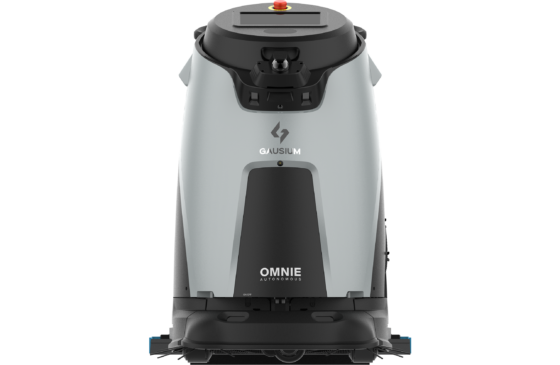
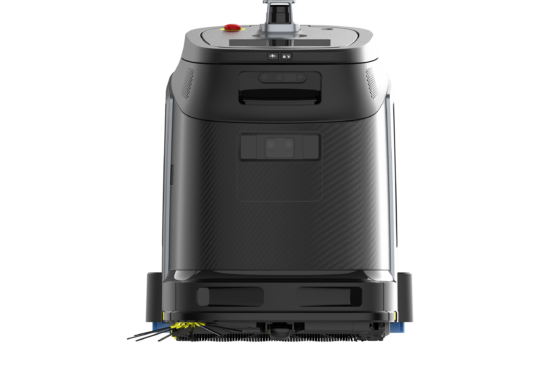
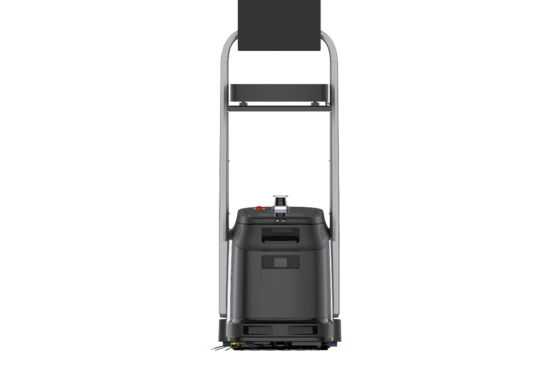
The product lineup — including the Phantas, Omnie, Beetle, and the newest additions Mira and Marvel — is designed to cover sweeping, mopping, scrubbing, and multi-function cleaning across all major vertical sectors. As Qin emphasized, no other manufacturer currently offers such a comprehensive robotic cleaning product portfolio.
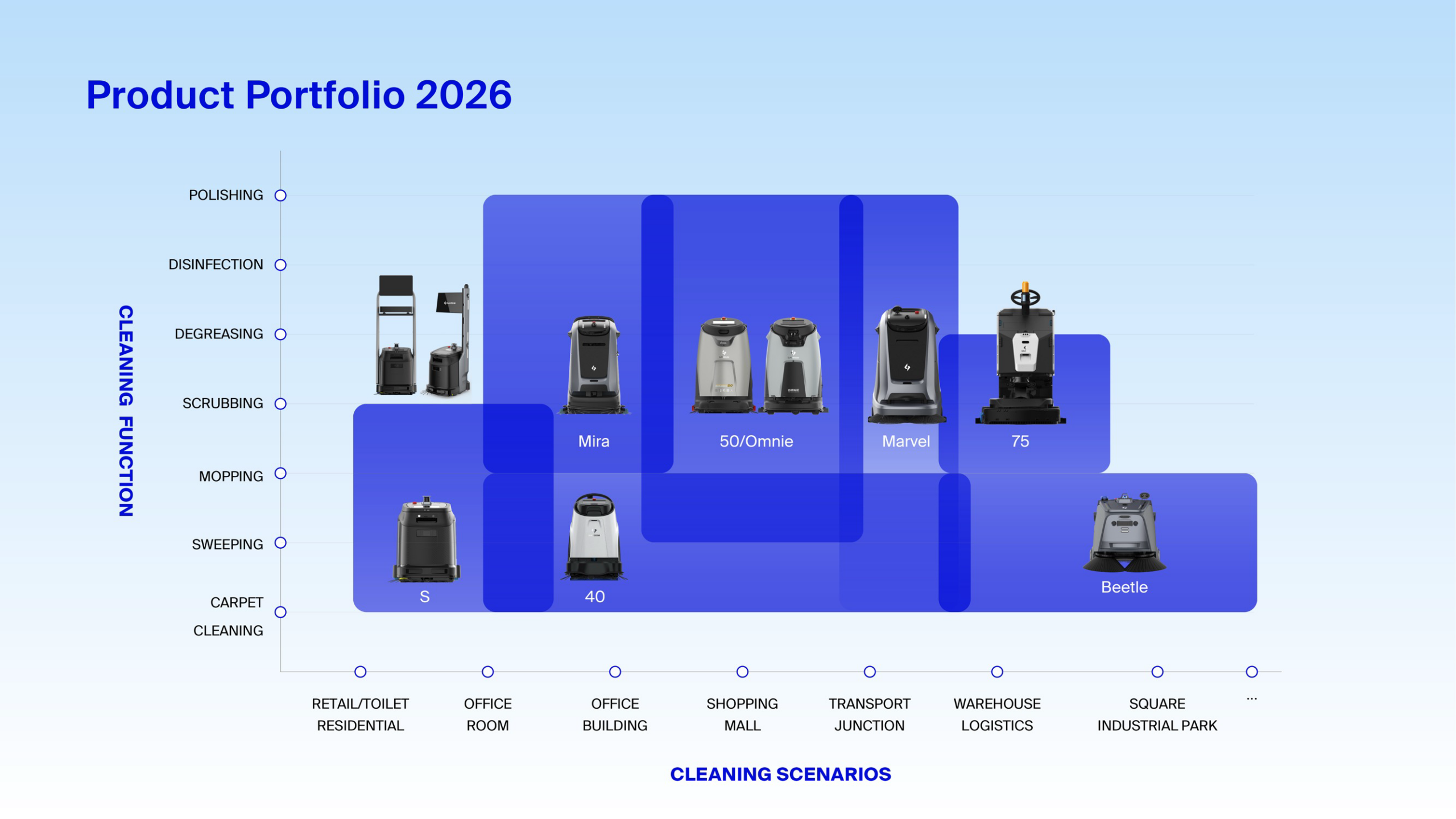
Gausium Product Portfolio 2026 (cr: Baoxing Qin, “The Anatomy of Autonomy: Gausium CTO Talk EP01”)
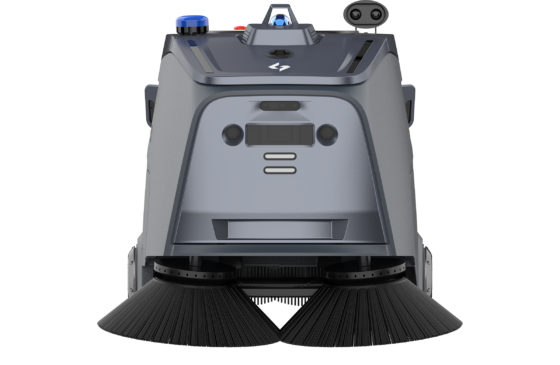
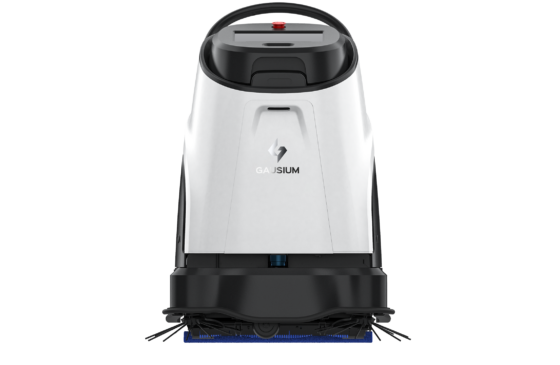
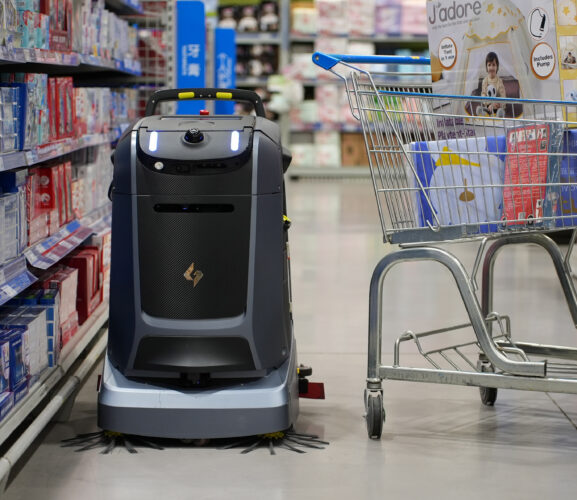
Mira, unveiled at CMS Berlin, is an autonomous floor scrubber built for mid-sized environments such as supermarkets and retail stores. It combines sweeping (via side brush and roller brush) with scrubbing (via disc brush) in a single pass — saving time and delivering professional-grade cleaning results. Mira also features an integrated self-cleaning system that automatically rinses its dirty water tank, dramatically reducing daily maintenance.
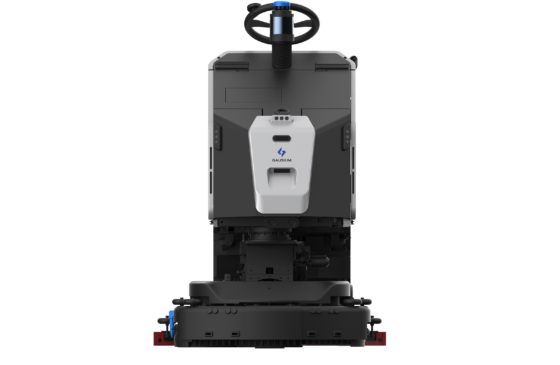
Marvel is Mira’s larger counterpart, designed for industrial warehouses and large-format retail spaces. Equipped with a heavy-duty side brush capable of handling larger debris such as paper and thread, and a disc brush for deep scrubbing, Marvel brings the same 2-in-1 cleaning power and self-cleaning technology to bigger spaces. Disc brushes were chosen over roller brushes for their superior scrubbing contact area and performance on hard floor surfaces.
Qin outlined four critical dimensions that define how autonomous cleaning robots evolve over time:
These four pillars form Gausium’s roadmap for moving the industry from basic robotic scrubbers through today’s autonomous and intelligent cleaning stage, and ultimately toward 3D space cleaning — including vertical surfaces and even toilets, enabled by robotic arms mounted on mobile platforms.
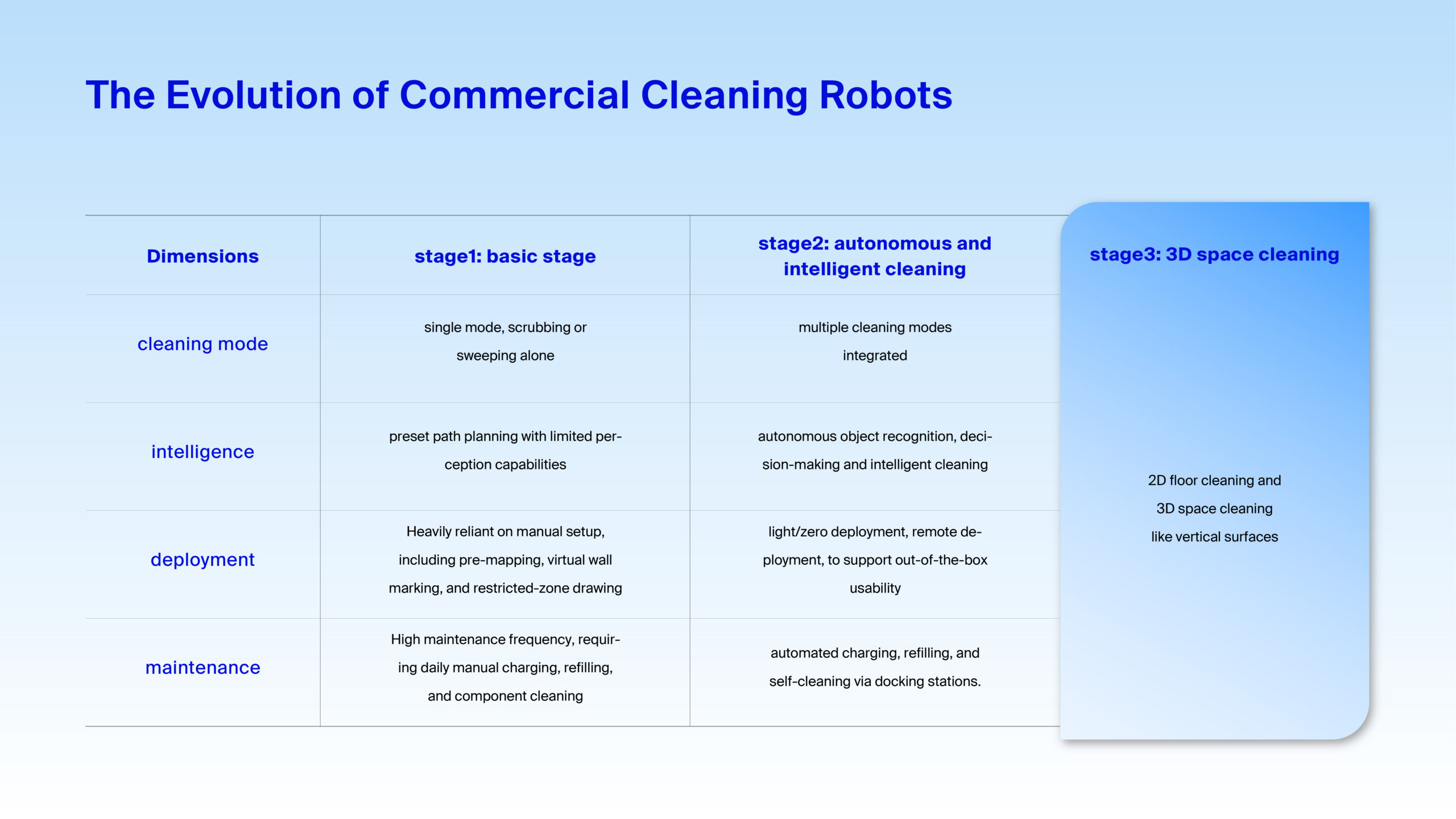
The Evolution of Commercial Cleaning Robots (cr: Baoxing Qin, “The Anatomy of Autonomy: Gausium CTO Talk EP01”)
One of the biggest operational bottlenecks in scaling a commercial cleaning robot fleet is deployment. Traditionally, skilled engineers must visit each site to map the environment, configure paths, and set up cleaning tasks. This model doesn’t scale when deploying hundreds or thousands of robots at once.
Gausium’s remote deployment solution changes this equation. A janitor or cleaner simply pushes the robot through the space. The robot maps the environment autonomously, uploads the data to the cloud, and a backend engineer handles map editing and task configuration remotely using 3D point cloud and camera data.
Even more ambitious is the “Drop & Go” mode, first showcased at the ISSA Show North America 2025. In environments that change frequently — like ballrooms or event venues where furniture is constantly rearranged — the robot can perform simultaneous mapping and cleaning with a single button press. It first explores the boundary, performs edge cleaning, then completes full coverage cleaning, all without any pre-existing map or deployment effort.
Autonomous cleaning robots were designed to free people from routine floor care, but many operators find themselves stuck in a cycle of daily robot maintenance: cleaning dirty water tanks, unclogging suction pipes, maintaining squeegees and brushes.
Gausium is systematically tackling this problem. The Phantas robot, for example, returns to its docking station after a cleaning task, automatically charges, refills fresh water, drains dirty water, and then enters a multi-cycle self-cleaning process for the squeegee, suction pipe, and dirty water tank. The new Mira and Marvel robots carry this self-cleaning capability onboard.
Looking ahead, Gausium is also working on automated roller brush cleaning and self-emptying trash bins — continuing the push to minimize human touchpoints throughout the robot’s operational lifecycle.
At the heart of Gausium’s competitive advantage is its AI and autonomous navigation stack. The intelligence layer operates on two fronts:
Autonomous Navigation: The robot must localize itself in complex environments, detect obstacles of all kinds (people, vehicles, escalators, carpets, wires, glass doors), and coordinate safely with humans and moving objects. Gausium’s sensor suite includes 360-degree 3D LiDAR and 360-degree camera arrays, enabling omnidirectional bird’s-eye-view (BEV) perception borrowed from the autonomous driving industry.
Intelligent Cleaning: Rather than cleaning every area with equal intensity, Gausium’s robots use AI-powered trash and stain detection to perform on-the-spot targeted cleaning. This approach can improve cleaning efficiency by up to four times compared to traditional full-coverage routines.
Qin broke down Gausium’s AI strategy into three foundational pillars:
Algorithm: Gausium continuously adopts cutting-edge techniques from the autonomous driving sector, including occupancy networks for generic object detection (identifying over 100 semantic object types), bird’s-eye-view perception models, and large visual models (LVMs) for high-level scene understanding and reasoning.
Data: With the world’s largest commercial cleaning robot fleet — over 40,000 units — Gausium commands the industry’s biggest training dataset. While the industry standard for object recognition tasks typically uses around 50,000 annotated samples, Gausium trains each task on over one million annotated data points.
Computing Power: Rather than chasing raw computing power, Gausium pursues efficiency through model distillation and network pruning, running a unified backbone across all detection tasks. The result: full 360-degree perception using only 6 TOPS (Tera Operations Per Second) of computing power, compared to the 100 TOPS typically required in the autonomous driving industry.
Gausium is fully GDPR-compliant, collecting training data exclusively from the China market, validating models there, and then deploying validated software upgrades to overseas fleets without collecting any customer data from international markets.
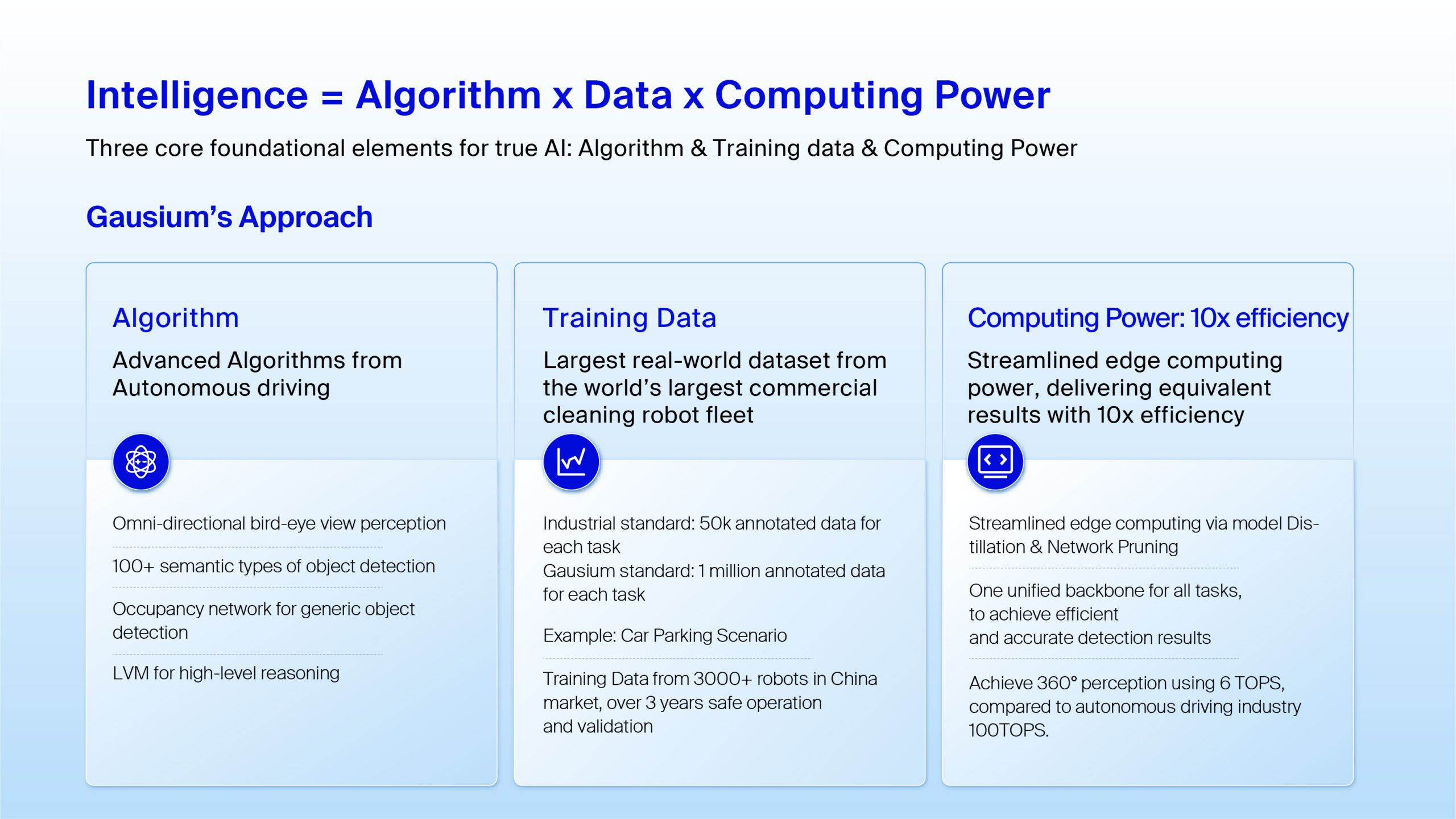
Gausium’s AI Strategy: Algorithm x Data xComputing Power (cr: Baoxing Qin, “The Anatomy of Autonomy: Gausium CTO Talk EP01”)
When asked what would differentiate Gausium in a head-to-head trial against competitors, Qin pointed to measurable performance across the four key dimensions:
Gausium’s roadmap makes one thing clear: the future of commercial cleaning robots extends far beyond flat floors. With plans for robotic arm integration, the company envisions robots that clean vertical surfaces, glass walls, and even restrooms — moving from 2D floor cleaning into full 3D space cleaning.
Backed by the world’s largest fleet, the industry’s deepest AI training dataset, and a relentless focus on reducing deployment friction and maintenance overhead, Gausium is positioning itself not just as a market leader, but as the company defining what autonomous cleaning looks like for the next decade.
This article is based on Gausium’s live webinar “The Anatomy of Autonomy: Gausium CTO Talk EP01,” featuring CTO Baoxing Qin and Global Strategic Marketing & BD Director Peter Kwestro.
UP NEXT
5 Key Features to Look for in a Professional Autonomous Cleaning Robot in 2026January 28, 2026

Step 1/2
Please select the type of business you’d like to have with Gausium.
Choose one item from the list
Step 2/2
Thanks for sharing your preference. Please fill out the form below, and we’ll get in touch shortly.
By clicking “Submit”, I authorize Gausium to contact me. Privacy Policy.
Thank you for filling out the form
By clicking “Submit”, I authorize Gausium to contact me. Privacy Policy.